
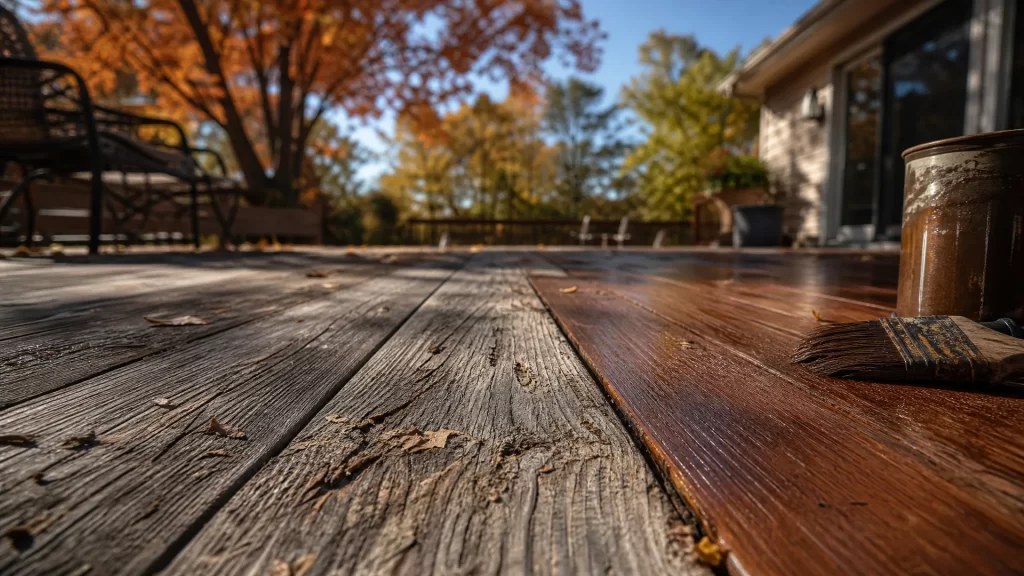
If your deck has gone a season or two without attention, Springfield’s weather has already started working against you. Deck staining in Springfield, MO is one of those maintenance tasks that feels optional right up until the wood starts cracking, graying, and splintering, at which point it stops being a cosmetic issue and starts being a structural one. At ColorTrends Painting, owner Steve Binger has spent over 30 years watching what Ozarks weather does to exterior wood, and the pattern is consistent: the homeowners who act early spend a fraction of what the ones who wait too long end up paying.
What Missouri Weather Does to Unprotected Wood
Springfield sits at a climate crossroads. Summers bring intense UV, 90-degree heat, and enough humidity to keep wood perpetually cycling between wet and dry. Winters follow with hard freezes and thaw cycles that repeat all season. That combination is genuinely harsh on unprotected wood, harsher than what you’d see in a more stable coastal or southern climate. Understanding how Springfield’s climate affects exterior coatings is the first step toward knowing why staining isn’t just cosmetic maintenance.
Heat, Humidity, and Freeze-Thaw Cycles in the Ozarks
Here’s what the cycle looks like in practice. Summer UV breaks down the lignin in wood, the natural binder holding wood fibers together. The wood grays, the surface raises, and small checks (surface cracks) start to form. Humidity then drives moisture into those checks. Come winter, that moisture freezes, expands, and widens the cracks further. By spring, what started as surface discoloration has become raised grain, splintering, and checks that run deeper than a sander can reach.
A deck that goes two or more summers without stain in this area typically shows deep gray oxidation, raised grain, and surface checks. Those conditions still respond well to stripping and a quality penetrating stain, but they worsen fast if left another season.
Deck Restoration vs. Replacement: The Real Cost Comparison
The first thing Steve does on every estimate walk-through is an honest wood condition assessment. His position is straightforward: deck restoration, cleaning, stripping, and restaining, costs a fraction of full deck replacement, and it’s the right call for the vast majority of Springfield decks. Replacement is the rare exception, not the default.
Signs Your Deck Can Still Be Saved
Sound structural boards are the deciding factor. If the framing, joists, ledger board, and load-bearing posts are solid, no rot, no significant structural checks, no soft spots underfoot, the deck can almost certainly be restored. Surface-level damage like gray oxidation, old peeling stain, and raised grain are preparation problems, not replacement problems. Our wood refinishing services at ColorTrends exist specifically for decks in this condition.
Check for soft spots by pressing a screwdriver into the end grain of boards and joists. If it sinks in easily, that board has rot. A few rotted deck boards are still a repair, not a replacement. When the structural members themselves are compromised, the math changes.
When Replacement Is the Honest Answer
Steve will tell you when a deck needs to come down, because sending you into a restoration project on a structurally failing deck would be a waste of your money and his reputation. The honest indicators: widespread rot through the framing, significant structural movement that can’t be corrected, or boards so deeply checked and degraded that no amount of prep will give stain a clean surface to penetrate. That’s a genuine minority of the decks we see. Most decks, even neglected ones, are worth saving.
The Deck Staining and Refinishing Process We Follow
Deck refinishing in Springfield, Missouri isn’t a one-step job. What separates a finish that lasts two or three years from one that peels before the next summer is almost entirely in the preparation, not the product.
Surface Prep: The Step That Determines How Long the Stain Lasts
Quality surface preparation, not the brand of stain, determines how long a deck finish lasts. An improperly prepped surface will cause even premium stain to peel or flake within a single Missouri summer. That’s not a sales point; it’s consistent with what every major exterior wood stain manufacturer states in their application guidelines.
The full sequence we follow:
- Clean the surface. Power washing or a deck-wash solution removes mildew, dirt, tannins, and any loose material. This step also lets us see the true condition of the wood.
- Strip old stain if needed. If there’s an existing film-forming stain that’s failing, it has to come off completely. Staining over a failing finish doesn’t extend its life, it just buries the problem.
- Sand or brighten. Sanding smooths raised grain and opens the wood. A wood brightener restores pH balance after stripping, which helps the new stain penetrate evenly.
- Assess before applying. Steve walks the deck again after prep to check for boards that need replacement and confirm the wood is in the right moisture range for stain application. You don’t apply stain to wet wood.
- Apply stain. Product is applied with attention to lap times and coverage rates, doing it right means no overlap marks, no dry spots, and consistent penetration across every board.
On the day itself, homeowners should expect the crew to work methodically and not rush the dry time between prep and application. If the weather isn’t cooperating, too humid, rain in the forecast, temperature below 50°F, we reschedule. Stain applied in the wrong conditions fails fast, and that’s not an outcome we’re willing to put our name on.
Choosing the Right Exterior Wood Stain for Springfield Conditions
The stain spectrum runs from clear to solid, and the right choice depends on the wood’s current condition and how much maintenance you’re willing to do going forward.
Clear and water-repellent stains offer the least UV protection but show the most natural wood grain. They’re appropriate only for new or recently refinished wood in excellent condition. In Springfield’s UV environment, clear stains typically need reapplication every one to two years.
Semi-transparent stains are the most common choice for structurally sound decks with moderate weathering. They penetrate the wood rather than sitting on top of it, which means they don’t peel, they wear. That makes reapplication easier because you’re not stripping a film. Semi-transparent stains still show wood grain and provide meaningful UV and moisture protection.
Solid stains work like a thin paint, they cover the grain and provide maximum UV and moisture protection. They’re the right call for wood with significant surface discoloration or enough weathering that a semi-transparent product wouldn’t produce a clean, even result. The trade-off is that solid stains can peel over time and require more prep work at reapplication.
Penetrating vs. film-forming is the other axis. Penetrating stains (most semi-transparents fall here) absorb into the wood fibers and won’t peel. Film-forming stains (most solids) sit on the surface and can fail at the film rather than wearing gradually. For Springfield’s weather cycles, penetrating products are generally more forgiving on maintenance. Knowing exterior paint and coating performance in the Ozarks helps put that product choice in context.
Steve matches product selection to the wood’s actual condition, not to what’s on sale or what’s easiest to apply.
Beyond the Deck: Fence Staining and Exterior Wood Staining in Springfield, MO
The same UV, humidity, and freeze-thaw cycles that damage your deck are working on your fence, pergola, and exterior wood trim. Fence staining in Springfield, MO is one of the most overlooked maintenance tasks homeowners put off, and fences face the same weather threats as decks, often with less protective overhang. Skipping fence maintenance regularly leads to premature replacement that staining every few years would have prevented entirely.
ColorTrends handles the full range of exterior wood staining projects: fences, pergolas, arbors, wood siding accents, and trim. The prep process is the same, clean, strip where needed, assess, apply, and the product considerations are the same. If we’re already on-site restoring your deck, adding the fence to the scope is a natural and efficient extension.
Wood staining in Springfield, MO works best as a whole-property approach rather than a piecemeal one. Matching stain tones across the deck, fence, and pergola gives the exterior a cohesive look that property-by-property patch jobs rarely achieve.
Get a Straight Answer from an Experienced Springfield Deck Refinishing Contractor
Steve Binger owns ColorTrends and works every job personally. There’s no sales team relaying your questions to a crew you’ve never met, when you call, you talk to Steve. When the estimate happens, Steve walks the deck himself. When the work starts, Steve is there.
That matters specifically for deck and wood restoration projects, because the condition assessment is everything. A salesperson’s job is to sell the job. Steve’s job is to tell you whether the project is worth doing and what it will actually take, because that’s how he’s built a reputation over 30 years in Springfield.
If he tells you 9am, be ready by 8:50.
The estimate is free, there’s no pressure, and you’ll leave the conversation knowing exactly what your deck needs, whether that’s a full restoration or just a cleaning and recoat. Request a free deck staining estimate and Steve will take a look, give you a straight condition assessment, and walk you through your options in plain language.
Your deck already has one Springfield winter behind it. Let’s make sure it’s protected before the next one.
Written by Steve Binger, owner of ColorTrends Painting in Springfield, MO. Steve has 30+ years of painting experience, has completed 400+ homes across his career including many in Southwest Missouri, and is Lead-Safe Certified. He personally handles every job from estimate to final walkthrough.
Ready to protect your deck in Springfield? Call or text Steve today at (417) 379-5587 for a free estimate.